


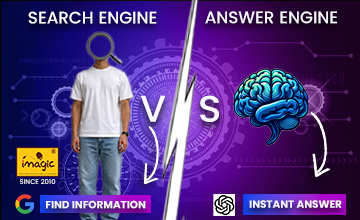
Search Engine vs Answer Engine — What’s the Real Difference?
You type a question online. Do you want ten blue links — or a direct answer? That simple preference is reshaping the entire internet. Welcome to the era of the Answer Engine.
The internet has always been about finding information. But how we find it is going through its biggest shift since Google launched in 1998. For students of digital marketing, web design, and creative technology — the distinction between a Search Engine and an Answer Engine is not just academic. It is changing how content is written, how websites are built, and how businesses get discovered online.
What is a Search Engine?
A Search Engine is a tool that crawls the internet, indexes billions of web pages, and returns a list of relevant links in response to your query. It does not answer your question directly — it points you toward sources that might.
Google, Bing, Yahoo
- Returns a list of links (SERP)
- You read and decide what’s relevant
- Multiple sources shown side by side
- User clicks through to websites
- Ranked by SEO signals & authority
- Great for research & exploration
ChatGPT, Perplexity, Gemini
- Gives a direct, synthesised answer
- Reads and processes sources for you
- Combines multiple sources into one
- User stays on the same platform
- Ranked by AI comprehension quality
- Great for specific, actionable answers
When you type “best graphic design courses in West Bengal” into Google, you get a page of results — blogs, directories, YouTube videos, institute websites. You then open each one and decide. That is the traditional Search Engine experience.
What is an Answer Engine?
An Answer Engine — also called AI-powered search or conversational search — reads those same sources and gives you one consolidated, conversational answer. Tools like ChatGPT, Perplexity AI, Google’s AI Overview, and Microsoft Copilot are answer engines.
Type the same query into Perplexity AI, and you get: “Top graphic design institutes in West Bengal include… They offer courses in… Fees range between…” — right there, no clicking required.
Search Engine vs Answer Engine — A Full Comparison
| Feature | Search Engine | Answer Engine |
|---|---|---|
| Output | List of links (SERP) | Direct conversational answer |
| User Effort | High — user must click & read | Low — answer delivered instantly |
| Technology | Crawling, indexing, ranking algorithms | Large Language Models (LLMs) + RAG |
| Examples | Google, Bing, DuckDuckGo | ChatGPT, Perplexity, Gemini, Claude |
| Best For | Exploration, research, browsing | Specific questions, quick decisions |
| Content Discovery | High — drives traffic to websites | Low — may reduce website clicks |
| Citations | Links ranked by authority | Sources cited within the answer |
| Personalisation | Based on location & search history | Based on conversation context |
| Follow-up Queries | New search required each time | Conversation continues naturally |
| Accuracy Risk | Low (links to original sources) | Moderate (AI can hallucinate) |
Real-World Scenarios
On Google: gets 10 blogs, YouTube links, and course ads. On ChatGPT: gets a structured 30-day learning plan with tool names, techniques, and practice tips — all in one reply.
Google returns articles to read. Perplexity gives a direct comparison with a recommendation — instantly.
Both work — but an answer engine skips the trip through multiple blogs and delivers the definition with examples in seconds.
How They Work Differently Under the Hood
Search engines use web crawlers — bots that constantly browse the internet, store page content in massive indexes, and use ranking algorithms (like Google’s PageRank) to decide which pages deserve the top spots. Factors like backlinks, page speed, keyword relevance, and mobile-friendliness determine your rank.
Answer engines use Large Language Models (LLMs) — AI systems trained on enormous text datasets. When you ask a question, the model either generates an answer from its training data or uses Retrieval-Augmented Generation (RAG) — fetching current web pages and constructing an up-to-date reply from them.
Why This Matters for Your Career
If you are studying Graphic Design, Digital Marketing, Web Development, or UI/UX — the rise of answer engines is directly relevant to your future work.
For Digital Marketers: Fewer people may click through to websites when answers are given directly. Content strategy must shift — writing in a way that AI tools reference and cite you is the new SEO.
For Web Developers: Structured data, schema markup, fast-loading pages, and semantic HTML become even more critical — these help AI systems understand and extract content from your site.
For UI/UX Designers: Conversational interfaces are becoming mainstream. Designing for chatbot flows, AI assistants, and voice interfaces is a growing skill set.
For all creatives: AI-generated answers make original, visual, and experiential content — the kind only humans create — more valuable, not less.
The IMAGIC Perspective
At IMAGIC Institute, we train students not just to use today’s tools — but to understand the thinking behind tomorrow’s tools. The shift from search to answer is one of the most important digital shifts happening right now. Our courses in Digital Marketing, Web Development, and UI/UX Design incorporate these evolving trends so that graduates are industry-ready — not outdated.
- Learn how to write content that both Google and AI tools rank highly
- Understand how LLMs and RAG systems work — explained in plain language
- Build websites optimised for the answer engine era (structured data, semantic HTML)
- Design conversational user experiences for the next generation of the web
Will Answer Engines Replace Search Engines?
Not entirely — at least not soon. Search engines still excel at discovery, local searches, product comparisons, and finding specific sources. Answer engines shine when you want a quick, reliable answer without clicking around.
The most likely future: hybrid engines — and we are already seeing it. Google’s AI Overviews appear above traditional results. Bing integrated ChatGPT. Even YouTube and Amazon are building conversational search features. The two models are converging.
What is clear is this: content quality, authority, and clarity will matter more than ever. Whether a human or an AI reads your content first — it must be accurate, well-structured, and genuinely useful.