
SEO vs AEO vs GEO: What Every Business Needs to Know in 2026
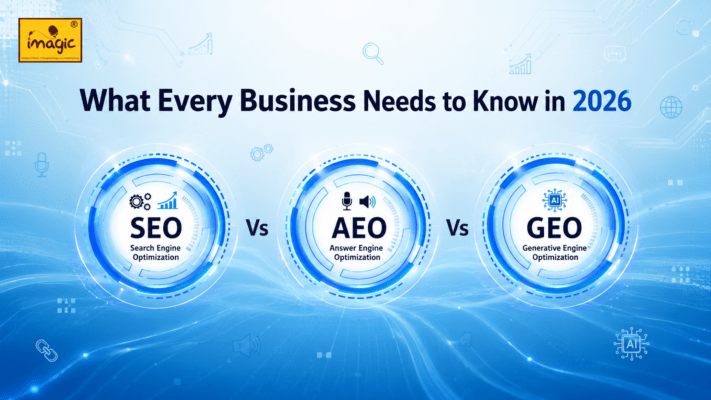
SEO vs AEO vs GEO: What Every Business Needs to Know in 2026 If you’ve been hearing terms like “AEO” and “GEO” alongside the familiar “SEO” and wondering whether they’re just buzzwords, you’re not alone. The truth is, the way people search for information has fundamentally changed — and the way businesses get found needs to change with it.
The Old World: SEO
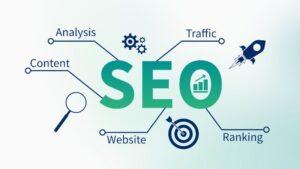
Search Engine Optimization (SEO) is the practice of ranking higher on search engine results pages, primarily Google. For nearly two decades, the playbook has been consistent: optimize your title tags, build backlinks, improve page speed, and target the right keywords so your website shows up on page one.
SEO still matters. Most people still type queries into Google and click through to websites. But it’s no longer the only game in town.
The New World: AEO
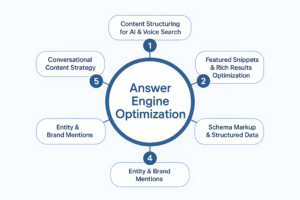
Answer Engine Optimization (AEO) is about being the direct answer, not just a link in a list of ten results. Think about Google’s AI Overviews, voice assistants like Alexa and Siri, or even a simple “People Also Ask” box. These don’t send users to your website — they pull a snippet of your content and display it instantly
To win at AEO, content needs to be structured very differently from traditional SEO content:
- Questions are answered in the first one or two sentences, not buried in paragraph four
- Headers are phrased as actual questions (“How much does a digital marketing course cost in Kolkata?”) rather than vague topic labels
- FAQ sections, comparison tables, and step-by-step lists are used heavily, because they’re easy for an answer engine to extract and quote
- Structured data (schema markup like FAQPage and and HowTo) tells search engines exactly what your content means, not just what it says
A business that nails AEO becomes the answer people see immediately, even if they never click through to the website.
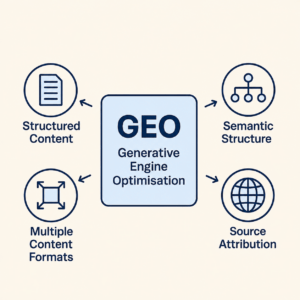
The Newest Frontier: GEO
Generative Engine Optimization (GEO) takes this one step further. It’s about getting mentioned or recommended inside AI chat tools like ChatGPT, Gemini, Claude, and Perplexity when someone asks a question conversationally — “What’s the best digital marketing course in Kolkata?” or “Which institute offers NSOU diploma courses?”
Unlike traditional search engines, these AI tools don’t just crawl your website. They draw on a much wider mix of sources: Reddit discussions, Quora answers, review platforms, news articles, and third-party “best of” lists. This means GEO success depends on:
- Being mentioned consistently across multiple independent sources, not just your own site
- Genuine reviews and testimonials on platforms AI models trust
- Digital PR and getting featured in listicles or comparison articles
- Strong, verifiable credibility signals — real data, real case studies, real author expertise (often called E-E-A-T: Experience, Expertise, Authoritativeness, Trustworthiness)
GEO is harder to control directly than SEO, because you’re influencing what AI models say about you rather than what your own website displays. But that’s exactly why businesses that start now will have a real head start.
Why Does This Matter Right Now?
Search behaviour is splitting into three parallel paths:
- Someone types a query into Google and scrolls through blue links — SEO territory
- Someone gets an instant answer box or AI Overview without clicking anywhere — AEO territory
- Someone asks ChatGPT or Perplexity directly and trusts whatever it recommends — GEO territory
A business optimizing only for the first path is already missing a growing share of how people discover services, compare options, and make decisions. Students researching courses, parents comparing institutes, and professionals upskilling are all increasingly asking AI tools these questions directly — which means institutes and businesses showing up confidently in classic search but invisible inside AI answers are leaving real opportunity on the table.
Getting Started ?
The good news: SEO, AEO, and GEO aren’t competing strategies — they build on each other. Solid SEO fundamentals (clean site structure, good content, technical health) are still the foundation. AEO adds structure and clarity on top of that foundation. GEO extends visibility beyond your own website into the wider web where AI models actually look for trustworthy answers.
Businesses that treat all three as one connected strategy — rather than chasing AEO and GEO as separate trends — are the ones who’ll stay visible no matter how someone chooses to search.
Frequently Asked Questions
What’s the difference between SEO and AEO? SEO focuses on ranking your website in search results so people click through to it. AEO focuses on getting your content extracted and shown directly inside an answer box, voice response, or AI Overview, often without a click at all.
Is GEO replacing traditional SEO? No. GEO works alongside SEO and AEO rather than replacing either. Strong SEO and clear, well-structured content are still what AI models and answer engines draw from in the first place.
Do small businesses need to worry about GEO yet? Yes, increasingly. Even small, local businesses are being recommended by name inside AI chat tools when people ask conversational questions, so early visibility in reviews, listicles, and trusted third-party sites compounds over time.
How can I start optimizing for AEO and GEO? Begin by restructuring key pages with clear question-based headers, concise direct answers, FAQ schema, and comparison tables, while also building genuine reviews and earning mentions on independent, trusted platforms.
Want to learn SEO, AEO, and GEO hands-on with real projects? IMAGIC‘s Digital Marketing Course in Kolkata now includes a dedicated module covering exactly this — from on-page SEO to schema markup to getting cited inside AI answers.